

One of the things I love most about traveling is studying culture, particularly the unique flavors of traditional clothing. The diverse way people of the world clothe themselves tells much more than their sense of fashion. Ethnic dress expresses their cultural and tribal heritage, values, lifestyle, and religion, transmitted from generation to generation.
In this era, which can sometimes homogenize global identity, I think it’s important to appreciate and preserve each nation’s distinctive roots in the form of their traditional garments.
So come along with me to places I’ve traveled around the world and taken advantage of putting on some of the most stunning and exotic traditional dresses in the world. Ethnic dress-up is so much fun and a great way to pay homage to historic international fashion.
Kimono
Photo location: Kyoto, Japan

Originating during the Heian period (about 794 to 1192 AD), Kimono translates as “thing to wear” and was the Japanese word for clothing, and until the 19th century, was the unisex dress of all Japanese people. Nowadays, the word is used to refer to traditional Japanese clothing worn during traditional ceremonies like weddings, funerals, and tea ceremonies.

Kimonos come in richly colored floral patterns consisting of a long undergarment called a nagajuban, a sash called an obi, the obiage, which holds the obi up, baggy sleeves, white cotton socks, and other sections. Draping this piece of clothing is not as easy as it looks. The women’s version has 12 different components and is difficult to put on without help. The completed exquisite outfit is also extremely heavy.

I had a very unique experience in the Gion district of Kyoto (where you can see geishas) – a three-hour makeover in which you are transformed into a maiko (geisha apprentice). Unlike the actual hard work involved in a real apprenticeship, the ethnic dress makeover experience allows you to live as a wannabe, if only for a few incredible hours.
Click here to read about my geisha makeover.
Kuylak
Photo location: Samarkand, Uzbekistan
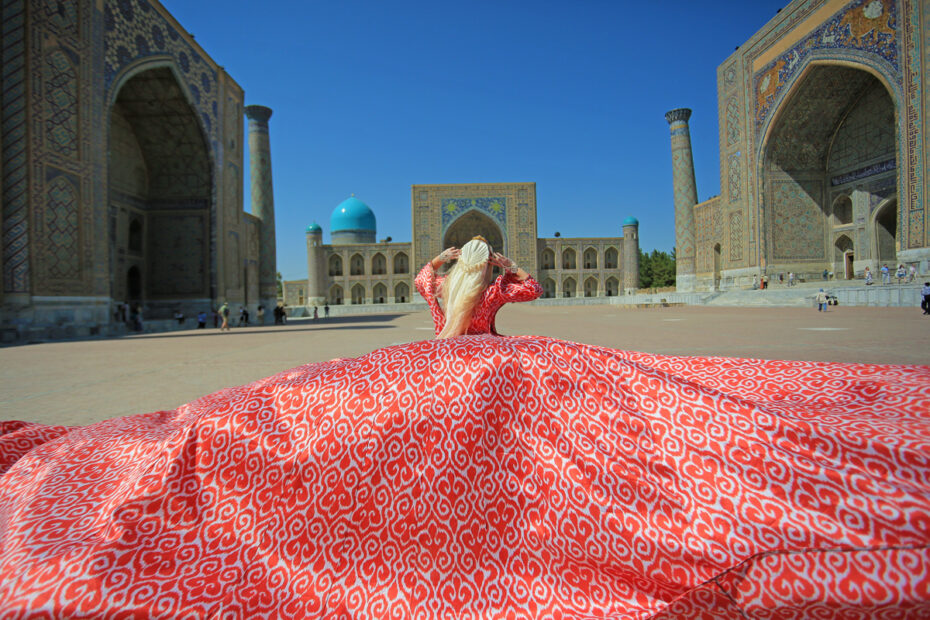
The traditional Uzbek women’s dress, known as a kuylak, is a long, loose-fitting garment celebrated for its graceful silhouette and vibrant fabrics. Typically reaching the ankles, it features a high neckline, long sleeves, and a flowing shape designed for comfort and modesty.
Silk, cotton, and colorful ikat fabrics have traditionally been used, often adorned with bold stripes, intricate patterns, and jewel-like colors. Decorative embroidery may embellish the neckline, cuffs, or hem, adding an artistic touch.
Women traditionally paired the kuylak with loose trousers called lozim, while scarves, embroidered caps, jewelry, and ornate belts completed the ensemble for festive occasions and celebrations.
The gorgeous filming spot in Samarkand, on of the most important stops im the legendary Silk Road, made this one of my favorite ethnic dress-up experiences.
Kebeya
Photo location: Ubud, Bali

Kebaya is officially recognized as the national attire of Indonesia. It consists of an elaborate, tight-fitting upper garment opened at the front, traditionally made from lightweight fabrics such as brocade, cotton, gauze, lace, or voile, and adorned with embroidery, lace, buttons, pins, or brooches.
The lower garment consists of a sarong-style skirt known as a kain, which is a long piece of cloth wrapped and tucked around the waist or under the armpits, either made out of ikat, batik, or similar fabric. Balinese kebaya adds an obi-like sash (seledang) wrapped around the waist.
Balinese women are required to wear a kebaya ethnic dress during Balinese Hindu rituals and pura ceremonies.
Click here to read 13 Things to Do in Bali. #8 Is a Hoot. #12 is Insane!
Flying Dress
Photo location: Istanbul, Turkey

I had two dress-up opportunities in Turkey. The first was called a “flying dress” photo shoot with a professional photographer.

While the costume was not a cultural dress, it was more about the traditional background on a rooftop with traditional Turkish cushions. It was so much fun!
Click here to read 3 Days in Istanbul – Turkey’s Magnificent City
Baroque
Photo location: Venice, Italy

In Baroque-era Venice, women’s clothing was a striking display of wealth, elegance, and extravagance. Gowns were crafted from luxurious fabrics such as silk, velvet, and brocade, often richly embroidered with gold or silver threads. Wide skirts, supported by structured petticoats, created dramatic silhouettes, while tightly fitted bodices emphasized the waist. Sleeves were elaborately designed, with lace cuffs and flowing ribbons. Masks and ornate accessories also played a significant role, especially during Carnival, when fashion evolved into an art form that reflected Venice’s love of spectacle and grandeur.
If you’d like to try this experience in Venice, visit Venice Dress Up Experience and use my code at checkout: LUGGAGEANDLIPSTICK to receive 10% off!
Kaftan
Photo location: Istanbul, Turkey

Originating in Asia, the kaftan has long been a cultural dress choice for various Islamic cultures where modesty has been encouraged for thousands of years. A variant of the robe, tunic, coat, or overdress, kaftans usually have long sleeves and reach to the ankles. In Turkey, it’s a loose-fitting garment made of rich, heavy fabrics, with patterns symbolic of royalty.
Click here to read 3 Days in Istanbul – Turkey’s Magnificent City
Hanfu
Photo location: Tongli, China

The Hanfu (“Han clothing”) is the oldest of China’s traditional clothing, dating back over 4,000 years ago when Huangdi’s consort, Leizu, made cloth with silk. It also had a far-reaching influence on neighboring Asian countries, such as Japan, Korea, and Vietnam.
Hanfu consists of a paofu robe, or a ru jacket worn as the upper garment with a qun skirt commonly worn as the lower garment.
Nowadays, people seldom wear a hanfu except on special occasions, such as festivals, cultural events, or wedding ceremonies. With its rich history and captivating beauty, it’s also widely used for photography.
Click here to read 10 Instagram Moments in Tongli, China.
Shapan
Photo location: Almaty, Kazakhstan
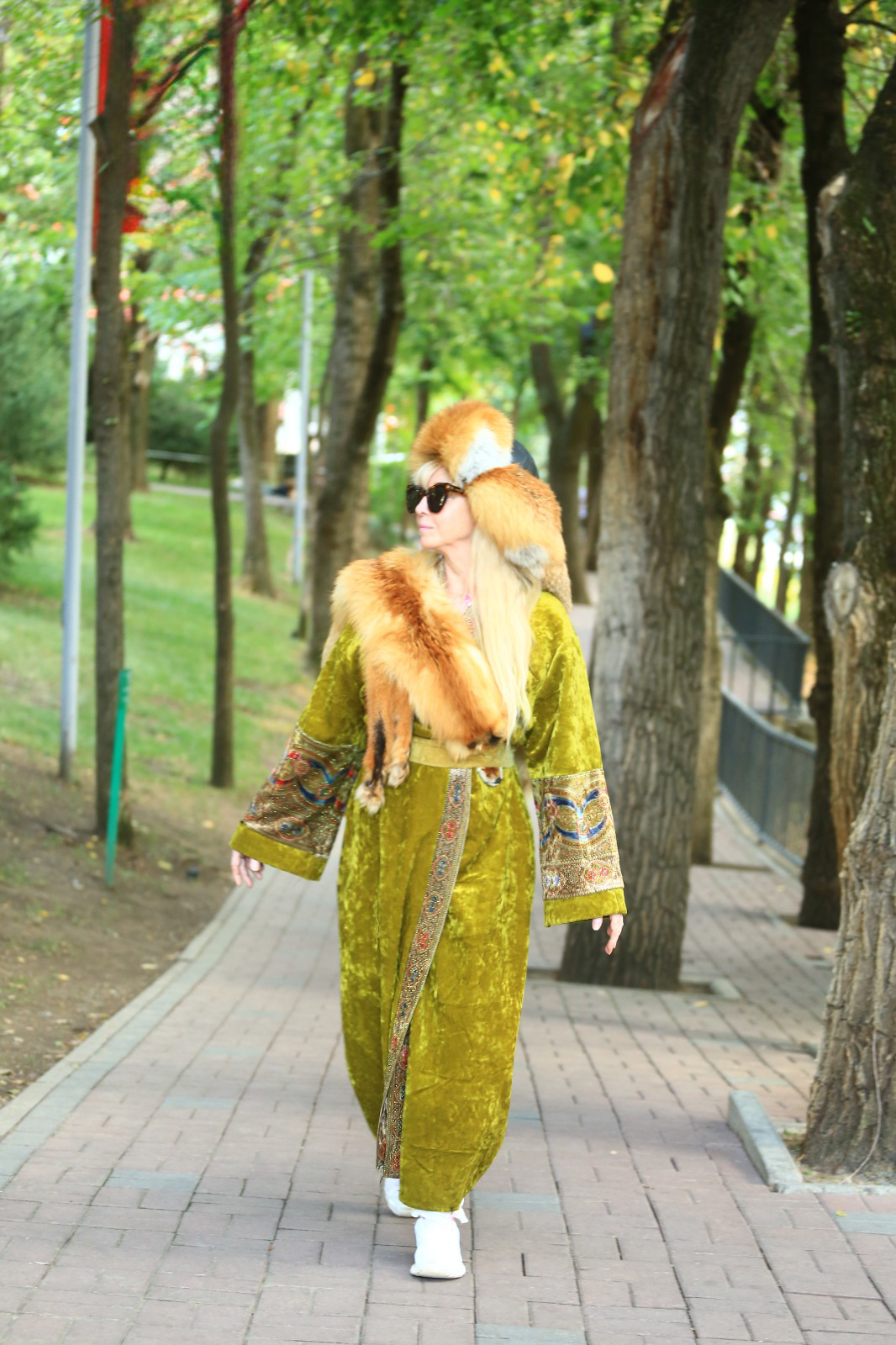
The traditional Kazakh shapan is a long, loose-fitting outer robe worn by both men and women. The heavy garment is usually made from velvet, wool, or brocade and features elaborate embroidery along the collar and sleeves.
The outfit is completed by a real fur hat and a real fur fox draped over the shoulder (coincidentally, identical to the one worn by my French great-grandmother, which I still have).
I drew the line at having a live falcon perched on my arm. Not a fan of animal tourism.
Ao Dai
Photo location: Hoi An, Vietnam

Ao dài (“long shirt”) is the national costume of Vietnam, symbolizing elegance. It consists of a long, slim-fitting silk tunic with long sleeves and a mandarin neckline in bright hues and patterns worn over loose-fitting pants.
The ao dai’s history dates back to the 18th century when it was worn by aristocrats. The word “áo dài” was originally used in the 18th century, during the Nguyen dynasty when Chinese-style clothing was in. Its modern look arose in the 1920s when it appeared at a Paris fashion show. During French rule, the outfit was redesigned as a modern dress, with a more Western silhouette.
Today many women in Vietnam wear this lovely feminine dress for work, everyday occasions, as well as special celebrations. I enjoyed wearing this ethnic dress for a Lantern Festival in Hoi An, but it’s also the only one on this list that I have worn more than once.
Click here to read Most Beautiful Places in Vietnam.
Medieval Dress
Photo location: Louisbourg, Canada

Women’s clothing consisted of an undertunic called a chemise usually made of linen with trumpet sleeves. Over the chemise, women wore one or more full, flared sleeveless ankle-to-floor length kirtles (gowns).
Peasants’ dress was made of cheap fabrics, while nobility wore dresses of the finest material available.
Click here to read Relive History at Louisbourg Fortress.
Tartan
Photo location: Edinburgh, Scotland

Tartan (referred to as “plaid” by Americans) has long been associated with Scotland. It is believed the material became popular in the 16th century, when it was worn by highlanders to identify each Scottish clan. The fabric epitomizes Scottish culture, worn by royalty and ruffians, conjuring misty, heather-laden glens and highland bagpipers wearing kilts.
Related: Scotland Folk Tours
American Wild West
Photo location: Indiana, USA

The iconic American Frontier Period (aka the “Wild West”) began with European colonial settlements in the early 17th century and ended with the admission of the last western territories as states in 1912. The history, legends, and folklore of the American frontier have embedded themselves into United States culture, shaping it as one of the defining characteristics of American national identity.
Saloon girls wore flashy ruffled skirts that were scandalously short for the time, sometimes above the knee in the front even though they were floor length with bustles in the back. Under the bell-shaped skirts could be seen colorful petticoats that barely reached their shoes. outfits also included visible garters and stockings, which were customarily considered underclothes.
It’s a common misconception that saloon girls were prostitutes. In reality, many women who worked in saloons earned money from dancing and drink sales, not from sex. They made more than prostitutes and, in general, were considered in a higher ranking.
Colonial Gown with Petticoat
Photo location: Colonial Williamsburg, Virginia
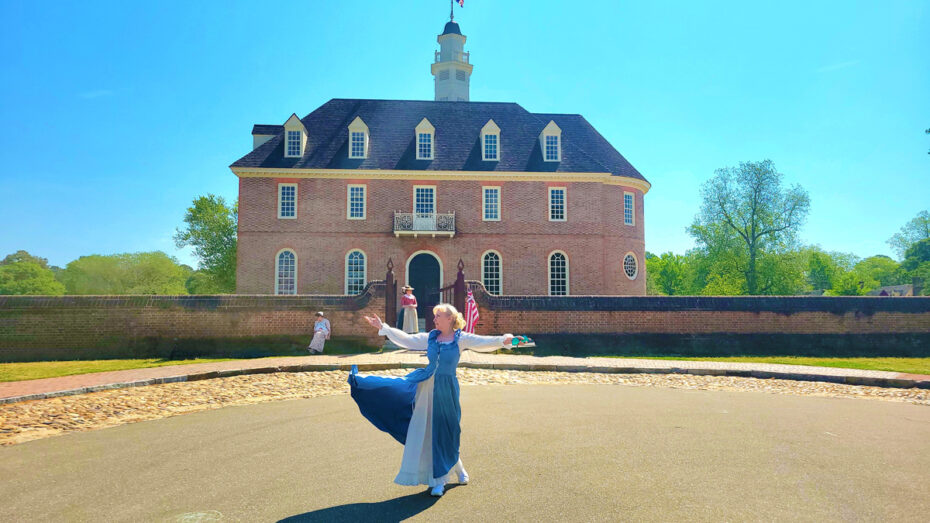
Colonial American women commonly wore a layered dress ensemble centered on a petticoat, a practical yet decorative white skirt or dress worn beneath or displayed with an open gown. The outfit typically included a fitted bodice, often laced or pinned, with a stomacher panel, and sleeves that could be elbow-length or full. Fabrics ranged from homespun wool and linen for daily wear to silk for formal occasions. The petticoat added warmth, structure, and visual richness, sometimes quilted or embroidered. Aprons, caps, and shawls completed the look, reflecting social status, regional climate, and the wearer’s access to imported textiles and skilled craftsmanship techniques.
Polleras
Photo location: Machu Picchu, Peru

Polleras are wide skirts, which were traditionally made from handwoven wool bayeta cloth. While polleras are used for traditional festivals and folklore, you can see these skirts worn by indigenous mezito when exploring urban places in Bolivia and Peru.
Especially during festivals, women can be seen wearing 4 or 5 pleated, embroidered skirts, one on top of another. The skirt worn under the top pollera is called the fuste; under the fuste (in the third skirt) is typically made from wool.
Click here to read How to Visit Machu Picchu.
Keffiyeh
Photo location: Wadi Rum, Jordan

Derived from the Arabic word ‘from the city of Kufa,” the history of the scarf called Keffiyeh began in Mesopotamia and was used by peasants as a way of protecting themselves against harsh weather, sun, and sand.
Usually worn by men across the Middle East, the fabric is normally white, red, and white, or black and white, and held in place by the agal, a black band.
Click here to read Wadi Rum: Camels, Bedouins, and Movie Sets.
Conical Hat
Photo location: Mekong River, Vietnam

The most recognizable Vietnamese item is the conical hat, or non la, an essential accessory that is meticulously handmade. Skilled artisans utilize bamboo or grass reeds to craft these iconic headpieces. Special conical hats in Vietnam contain colorful hand-stitch depictions or words and are quite fashionable.
The design of conical hats forms a pointed, circular cone that tapers smoothly, protecting wearers from the sun and gliding raindrops away from the face.
In Vietnam, the nón lá, nón tơi (“hats”), nón gạo (“rice hat”), nón dang (“conical hat”) or nón trúc (“bamboo hat”) Special conical hats in Vietnam contain colorful hand-stitch depictions or words.
Click here to read Most Beautiful Places in Vietnam.
Sombrero
Photo location: Progreso, Mexico

The word Sombrero derives from the Spanish word sombra (“shade”). The wide-brimmed hat from Mexico usually has a high-pointed crown and is used to protect from the intense sun. Craftsmen believe that Sombreros were first made by the Zenú group, more than 300 years ago.
Click here to read Progreso Beach & Attractions.
Manchu Headpiece
Photo location: Goddess Stream, China

The Qing Dynasty (1644 – 1912) was the final ruling dynasty before the establishment of the Republic of China. The Qing Dynasty Manchu headpiece was placed upright at the crown of a woman’s head. Her hair was then divided into two and wound around the frame, teased and pinned into the requisite shape.
Click here to read Cruising China’s Gorgeous Three Gorges.
Honorable Mention
The entries below are for traditional outfits that I purchased abroad but did not get the opportunity to be photographed in them in that country.
Cheongsam

The cheongsam (qipao) evolved from the Manchu women’s changpao (“long gown”) of the Qing Dynasty (1644–1912). The high-necked, close-fitting dress with a slit in the skirt originated during Manchu rule in China during the Qing dynasty in the early 1600s.
The typical cheongsam in China today was popularized by the socialites in Shanghai in the 1920s. Though the cheongsam’s popularity in Shanghai waned during the Communist Revolution, in the 1980s, it made a comeback, and it remains one of the oldest national costumes still in use. The dress is usually made from rich, bright-colored Chinese silk with floral patterns, particularly cherry blossoms.
Ruean Ton
Ruean Ton is one of the most casual and straightforward outfits out of all the eight women’s outfit types in Thailand. Consisting of a tube-like skirt worn with a collarless blouse, it is usually worn for non-official functions. It consists of a sinh (a long, tube-style skirt) in a solid color, embroidered, or striped, and an elbow-length sleeved blouse with a row of buttons but without a collar which is tucked into the skirt.
Sari/Saree

You can spell this elegant Asian dress either way – both acceptable spellings.
The word “sari” means “strip of cloth” in Sanskrit, originating from the Indian subcontinent. It’s the most well-known piece of traditional Indian clothing, still worn by women. It consists of a long, approximately 6-foot-long piece of un-stitched stretch woven fabric arranged over the body as a robe, with one end attached to the waist, while the other end rests over one shoulder as a shawl.
The sari is often worn with a fitted bodice also called a choli and sometimes with a petticoat.
Conclusion
I hope you enjoyed this preview of ethnic dress-up around the world as much as I did in doing it! I’m hoping to do more ethnic dress-ups in my future travels.
Click below to PIN so you can find ethnic dress-up again:

This article may contain affiliate/compensated links. For full information, please see our disclaimer.
About the Author
Patti Morrow is a freelance travel writer and founder of the award-winning international blog Luggage and Lipstick and the southern travel blog Gone to Carolinas. TripAdvisor called her one of the “20 Baby Boomer Travel Bloggers Having More Fun Than Millennials” and she was named one of the “Top 35 Travel Blogs” in the world.
She is also the star of the upcoming TV series “Destination Takeover” which is scheduled to premiere in the next few months.
Patti is the author of the book “Girls Go Solo: Tips for Women Traveling Alone,” and has over 150 bylines in 40 print and online publications, including The Huffington Post, International Living Magazine, Washington Post Sunday Travel, Travel Girl, Travel Play Live Magazine, and Ladies Home Journal. She has traveled extensively through six continents looking for fabulous destinations, exotic beaches, and adventure activities for her Baby Boomer tribe.

2 comments
Comment by Suzanne Fluhr
Suzanne Fluhr June 3, 2024 at 12:08 pm
Fabulous post. This is a nice round-up of your dress ups. I don’t know any other travel writer who makes it a point to try on traditional dress. I’m sure the locals are pleased that you make the effort.
Comment by luggageandlipstick
luggageandlipstick June 3, 2024 at 12:14 pm
Thank you! It’s actually one of my favorite things to do, and I research ahead of time to see if there are any opportunities. Sometimes, if no formal photo ops, I create them myself. It’s kind of my niche, especially in the Boomer demographic, and ties in nicely with my branding. Thank you for your kind words, they’re much appreciated.