
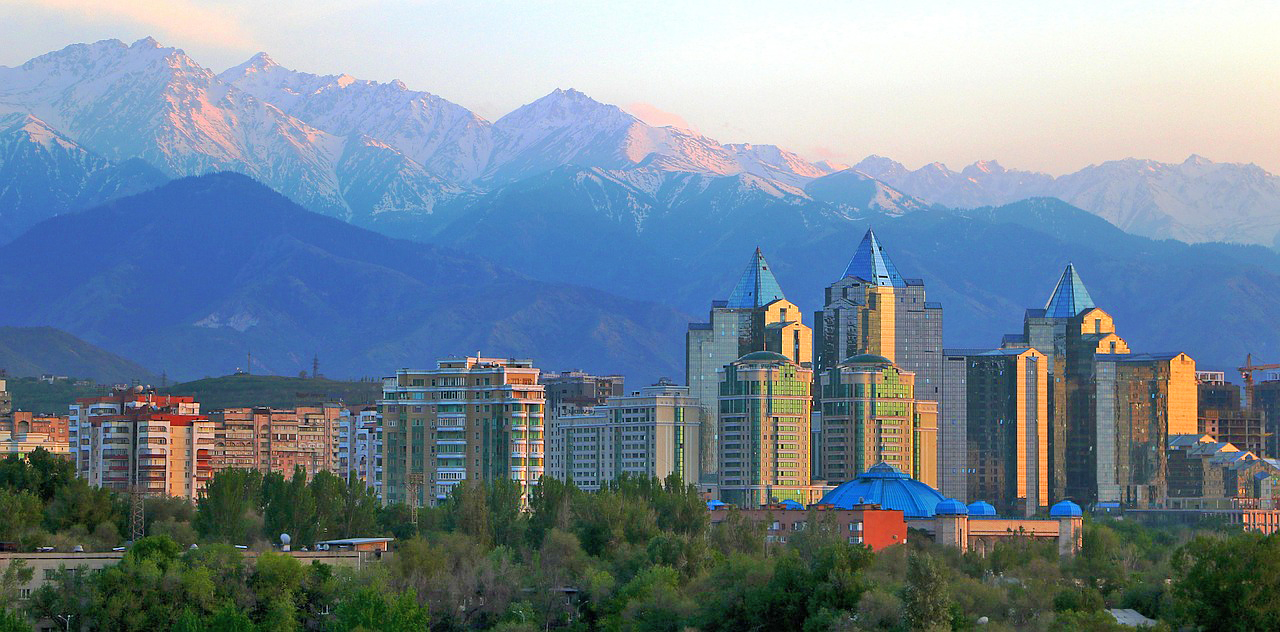
Almaty sits where the city meets the soaring Tian Shan Mountains, creating a destination with two very different personalities. Once part of the network of Silk Road routes crossing Central Asia, the city inherited a rich mix of cultures, foods, and traditions. It is also closely associated with the apple, with the wild ancestor of today’s cultivated apple native to the mountains surrounding the city. Today, broad, tree-shaded streets give way to bustling markets, grand squares, and colorful historic buildings, while snow-dusted peaks rise dramatically beyond the skyline. There’s almost no limit to the things to do in Almaty.
Follow the road into the mountains, and the scenery changes completely. Alpine lakes shimmer beneath rugged peaks, mineral-rich hot springs hide inside a forested gorge, and an immense canyon stretches across the steppe in waves of red and gold. In the city, whimsical apple sculptures celebrate Almaty’s connection to the fruit, while beyond the skyline, spectacular mountain scenery beckons. Almaty makes it remarkably easy to combine urban exploration with wild mountain landscapes.
Brief History
- 2nd century BCE – The Almaty region became connected to the growing network of Silk Road routes linking China with Central Asia, the Middle East, and eventually Europe. Caravans carried silk, spices, precious metals, horses, and other goods through the region, while travelers spread languages, religions, technologies, foods, and customs. This centuries-old exchange helped establish Central Asia as a vibrant crossroads of cultures.
- 1854 – The Russian Empire established the Verny military fort near the site of present-day Almaty. The settlement grew around the fortress and became an important center for trade and administration in the region.
- 1867 – Verny became the administrative center of the newly created Semirechye Oblast. Its location near routes connecting Central Asia and China helped the city develop into an important commercial crossroads.
- 1921 – The city was renamed Alma-Ata after the Bolshevik Revolution and the establishment of Soviet rule. It later became the capital of the Kazakh Soviet Socialist Republic, a role it held until 1997.
- 1991 – Kazakhstan declared independence following the dissolution of the Soviet Union. Alma-Ata became the capital of the new republic, and in 1993 the city officially adopted the name Almaty. The capital moved to Astana in 1997, but Almaty remained Kazakhstan’s largest city and its major cultural, financial, and commercial center.
12 Arbat Almaty
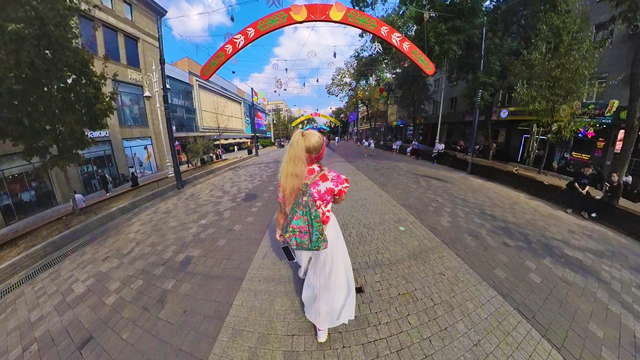
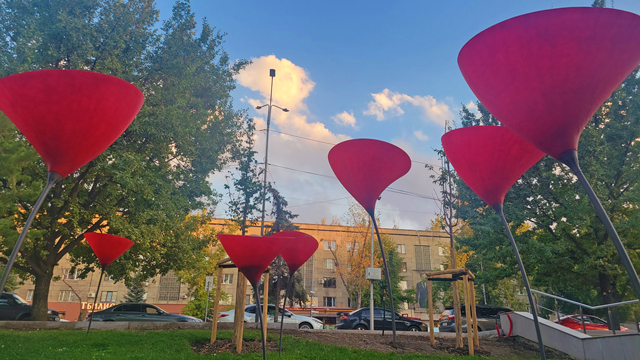
Arbat Almaty is a lively pedestrian street where art, music, cafes, and street performers animate the city center. The broad walkway is lined with shops and colorful public art, including whimsical apple sculptures that celebrate Almaty’s connection to the fruit. It is a favorite place to stroll, browse, and watch city life unfold.
11 Panfilov Walking Street
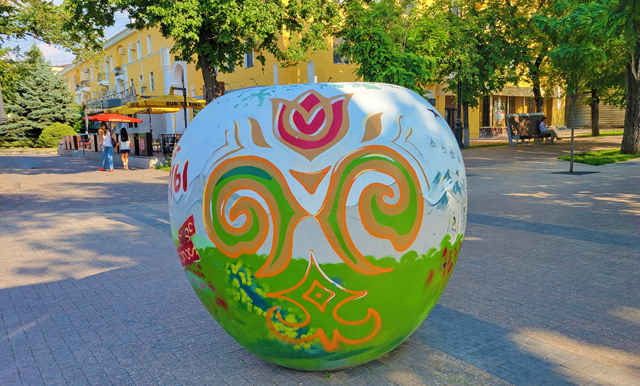
Panfilov Walking Street is one of those places where Almaty’s personality spills into the open. Mature trees form a leafy canopy over the pedestrian promenade, while cafes, restaurants, benches, fountains, and public art give the street a relaxed, lively rhythm. Locals gather here to chat, stroll, and enjoy the fresh mountain air, while visitors can wander without worrying about traffic. Among the colorful touches along the promenade are whimsical apple sculptures, a playful nod to the fruit that has become one of the city’s most recognizable symbols.
The street takes its name from the Panfilov Guardsmen, soldiers of the Soviet 316th Rifle Division who fought during World War II. It also provides an easy route to several of central Almaty’s most important sights, including the Memorial of Glory and Ascension Cathedral. Walking along Panfilov Street feels less like checking off attractions and more like watching Almaty unfold around you, with history, everyday life, greenery, and mountain views woven together. The whimsical apples add a splash of local personality to the historic surroundings.
10 Green Bazar
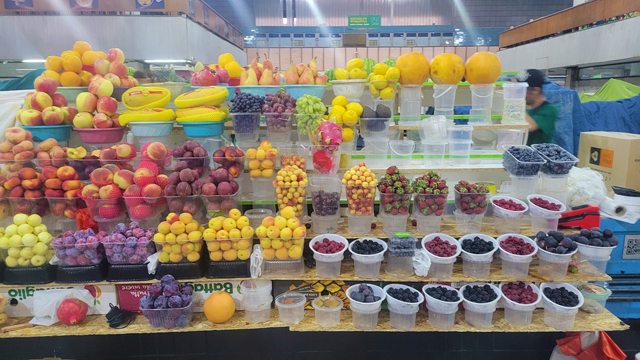
Step through the doors of Green Bazar, and the quiet of the street gives way to a riot of color, fragrance, and conversation. Bins and stalls overflow with jewel-like dried fruits, pyramids of nuts, fragrant spices, cheeses, sausages, sweets, and fresh produce. The market continues a much older tradition of commerce in a city shaped by the Silk Road, when merchants, travelers, and caravans carried goods and ideas across Central Asia. Vendors call out to customers while shoppers weave through the crowded aisles, creating the wonderfully chaotic atmosphere of a traditional Central Asian marketplace.
The market has been part of Almaty’s commercial life since 1875, when the area became an important trading point for merchants traveling through the region. Today, Green Bazar remains a delicious window into the city’s multicultural character and its centuries-old trading heritage. Try kurt, a salty, tangy dried cheese, or baursak, golden nuggets of fried dough that are especially good when fresh. The colorful displays and unfamiliar aromas make wandering the market feel like stepping into a living continuation of Almaty’s trading past.
9 Republic Square
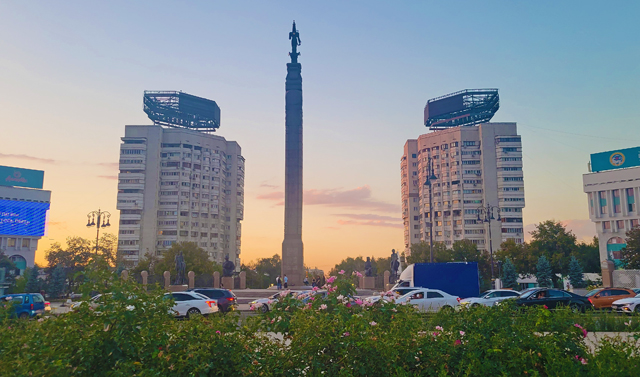
Republic Square opens across central Almaty in a grand sweep of pavement and monumental architecture, its enormous scale reflecting the ambitious urban planning of the Soviet era. Created in 1975, the square became the setting for official ceremonies, celebrations, and major public gatherings. Today, it remains one of the city’s most imposing spaces, but the dramatic Tian Shan Mountains rising beyond Almaty’s buildings soften the monumental surroundings with a spectacular natural backdrop.
The centerpiece is the Independence Monument, completed in 1996 to celebrate Kazakhstan’s independence in 1991. Atop its tall column stands the Golden Man, a golden warrior inspired by the famous ancient burial discovery near Almaty. The original warrior wore an elaborate costume covered with thousands of gold ornaments, and the figure has become an important symbol of Kazakhstan’s ancient heritage. Standing beneath the monument connects the modern city with a history stretching back thousands of years.
8 Memorial of Glory
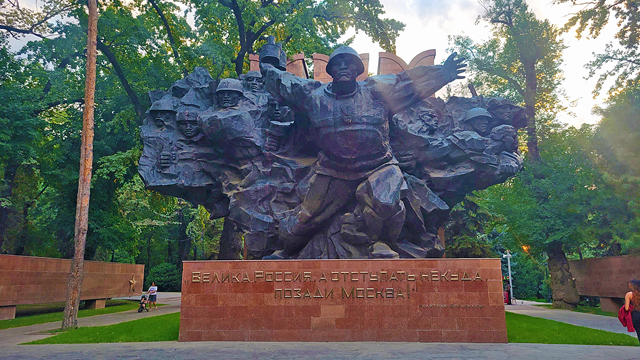
The Memorial of Glory rises from the greenery of Panfilov Park with a powerful, almost theatrical presence. Huge dark sculptures depict soldiers in dramatic poses, their angular forms seeming to surge forward from the stone. Completed in 1975 for the 30th anniversary of the Soviet victory in World War II, the memorial honors the soldiers from Kazakhstan who fought and died during the conflict. Its immense scale and stark design create an atmosphere of solemnity amid the surrounding trees.
An eternal flame burns before the monument, its small, steady glow contrasting with the massive figures behind it. The memorial is particularly striking when approached through Panfilov Park, where pathways shaded by mature trees lead from one historic landmark to another. Nearby, the brightly painted Ascension Cathedral creates a fascinating visual counterpoint. Together, the park and its monuments reveal layers of Almaty’s past, from imperial Russia to the Soviet era and the independent nation that followed.
7 Children’s Museum
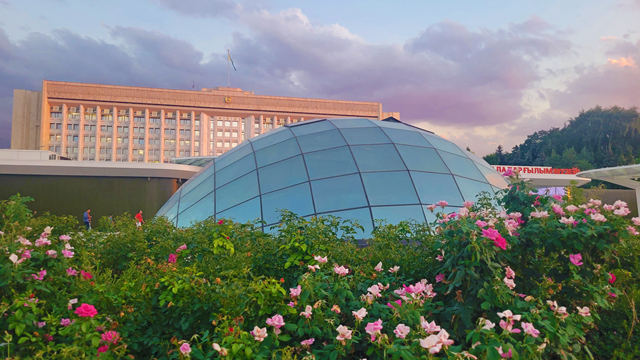
The Almaty Children’s Science Museum, located beneath Republic Square, transforms a former underground complex into Central Asia’s first interactive science center. Prominently marked by its striking glass dome skylight rising above lush surface rose gardens, the subterranean facility features over 200 hands-on exhibits covering space, technology, and regional history.
6 Ascension Cathedral
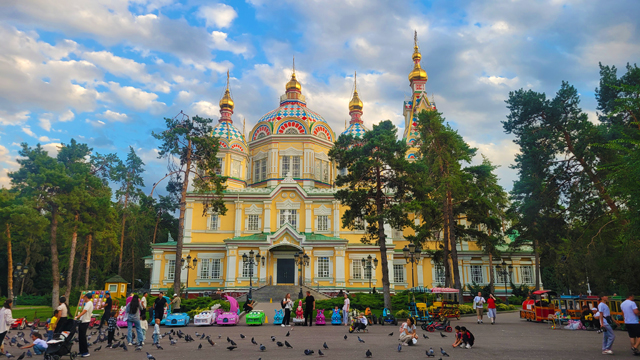
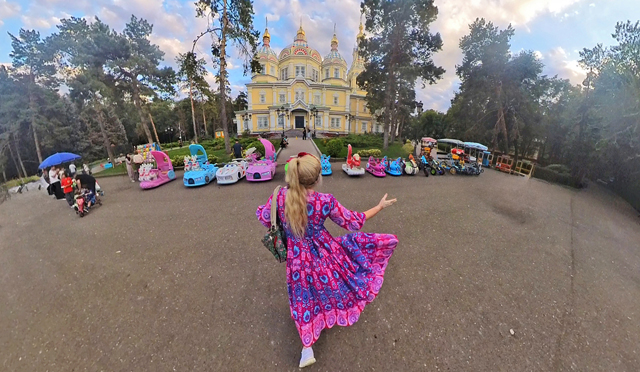
Ascension Cathedral looks almost too colorful and delicate to be made of wood. Its yellow walls, white ornamentation, green and gold details, and soaring towers create a striking splash of color among the trees of Panfilov Park. Completed in 1907, the Russian Orthodox cathedral was designed by architect Andrei Zenkov and constructed almost entirely from wood, an unusual choice for such a monumental building.
Its greatest story, however, may be the earthquake of 1911. A devastating earthquake struck Almaty, then known as Verny, destroying or badly damaging buildings throughout the city, yet the wooden cathedral survived. Inside, painted icons, religious artwork, carved details, and glowing gold decoration create an atmosphere far removed from the bustle outside. During the Soviet period, the cathedral was closed and used for secular purposes before eventually returning to religious use in the early 1990s. Its colorful appearance and remarkable survival make it one of Almaty’s architectural treasures.
5 Kok Tobe
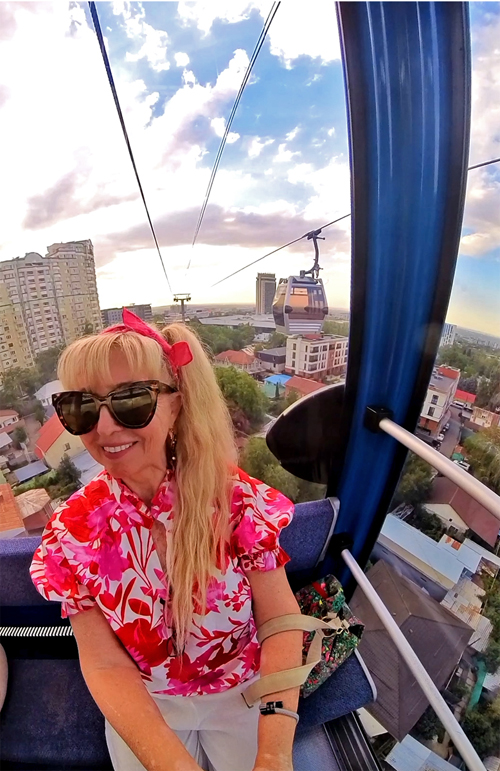
Kok Tobe feels like Almaty’s rooftop, perched high above the city with the Tian Shan stretching across the horizon. The journey begins with a cable car that glides upward from the city, carrying passengers over rooftops and treetops as the urban landscape gradually shrinks below. By the time the cabin reaches the summit, the city spreads across the plain like a vast mosaic, with the mountains forming a dramatic wall in the distance.
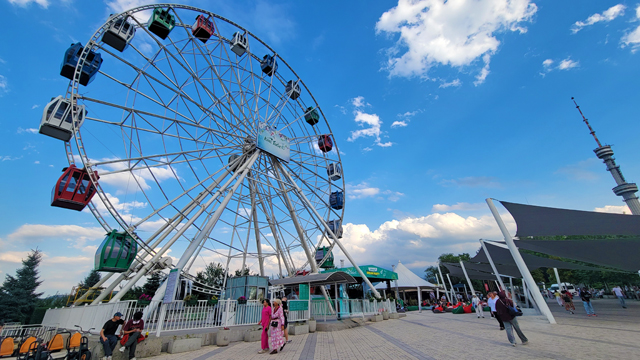
At roughly 3,700 feet above sea level, the summit offers plenty to explore, including walking paths, restaurants, cafes, gardens, viewing areas, and the towering Kok Tobe television tower.
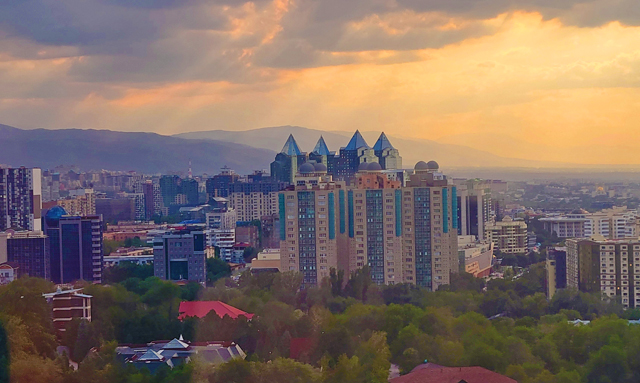
The atmosphere becomes particularly enchanting in the evening, when the last sunlight washes the mountains in gold, and Almaty’s lights begin flickering on below. Watching the city transition from daylight to a glittering nighttime panorama is one of the most rewarding experiences on Kok Tobe.
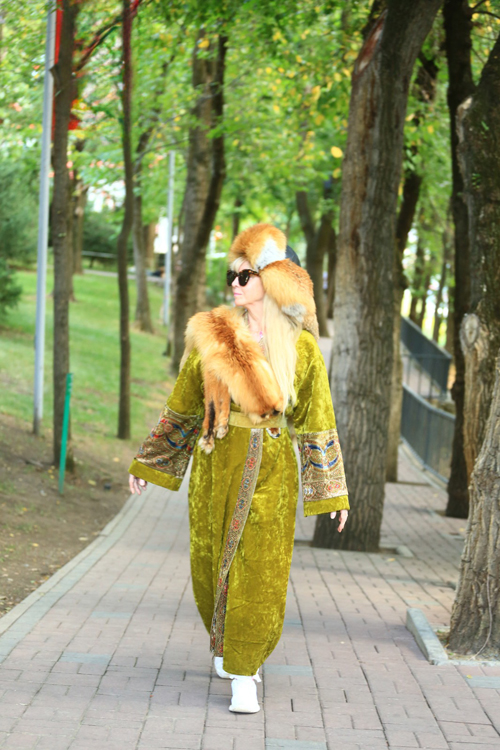
One particularly fun thing to do is the dress-up photo op wearing a traditional Kazakh shapan, a long, loose-fitting outer robe worn by both men and women. The heavy garment is usually made from velvet, wool, or brocade and features elaborate embroidery along the collar and sleeves. The outfit is completed by a real fur hat and a real fur fox draped over the shoulder
4 Kolsai Lake
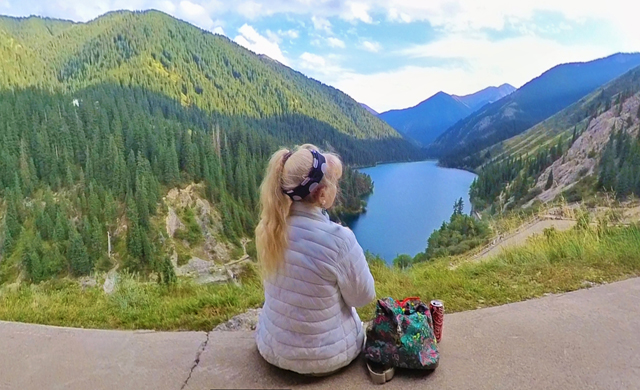
Kolsai Lake looks like someone dropped a sheet of brilliant blue glass into the middle of the Tian Shan. In reality, it is part of a chain of three alpine lakes tucked into steep mountain valleys southeast of Almaty. The first lake is the easiest to reach and is surrounded by dark evergreen forests, rugged slopes, and towering mountains. Depending on the light, the water shifts from deep blue to greenish shades, reflecting the forested mountainsides around it.
The lakes were shaped by geological forces, including landslides that created natural dams across mountain valleys. Today, the area feels wonderfully untamed, with hiking trails following the shoreline and climbing toward higher viewpoints. Longer treks lead toward the second and third lakes for those seeking a more demanding adventure. The journey from Almaty takes several hours, but the changing scenery makes the drive worthwhile as city streets give way to open steppe, mountain roads, forests, and increasingly rugged peaks.
3 Alma Arasan Hot Springs
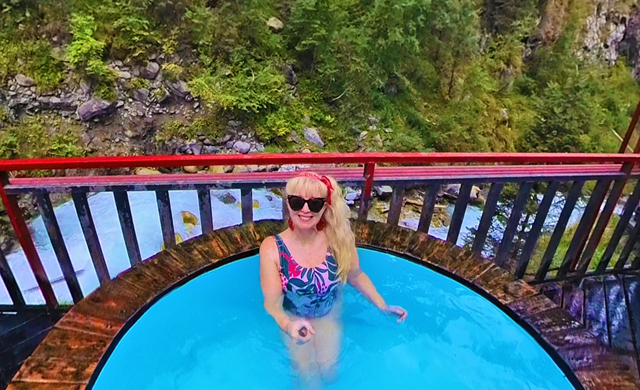
Alma Arasan Hot Springs is tucked inside the dramatic Alma Arasan Gorge, where steep mountain slopes rise above a rushing river and dense greenery clings to the rocky landscape. The name Alma Arasan is associated with the apple-rich region surrounding Almaty, and the area has long been known for its mineral springs. After leaving the city behind, the road winds deeper into the mountains until the urban landscape seems wonderfully distant.
The springs offer a chance to soak in naturally heated, mineral-rich water while surrounded by cool mountain air and the rugged scenery of the gorge. The contrast is what makes the experience so appealing: warm water, rocky cliffs, forested slopes, and the sound of rushing water all come together in one setting. Trails through the gorge add an adventurous element, allowing visitors to explore the mountain landscape before settling into the soothing waters.
2 Charyn Canyon
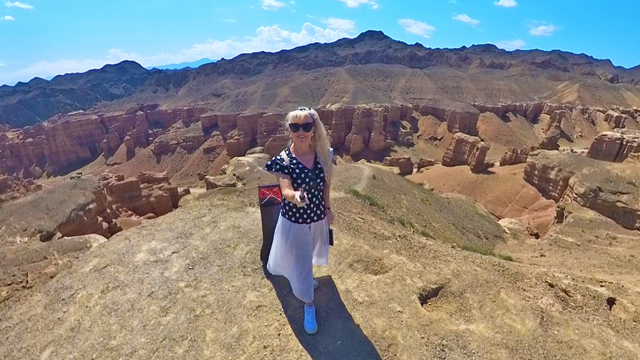
Charyn Canyon is the kind of landscape that makes the surrounding steppe seem almost otherworldly. Stretching for roughly 56 miles along the Charyn River valley, the canyon is carved into layers of sedimentary rock that have been exposed and sculpted by millions of years of erosion. Walls of rust, copper, ochre, and deep red rise from the landscape, their shapes twisted into towers, cliffs, pinnacles, and narrow corridors.
The most spectacular section is the Valley of Castles, where enormous rock formations stand shoulder-to-shoulder like the crumbling towers of a forgotten fortress. Walking into the canyon reveals new shapes at every turn, with sunlight igniting the upper walls while shadows gather in the narrow passages below. The Charyn River continues to flow through the valley, while the surrounding landscape feels vast and ancient. It is a place where geology becomes the main attraction, written into the cliffs in layer after layer of stone.
1 Big Almaty Lake
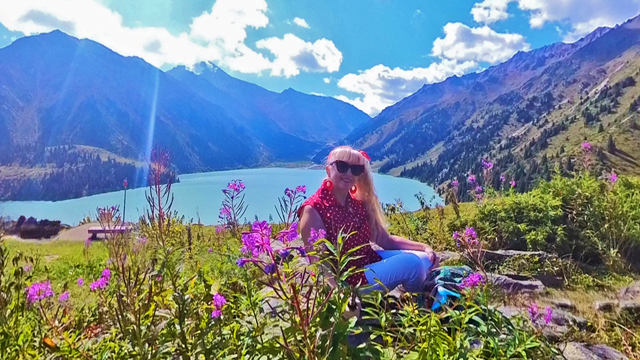
Big Almaty Lake is the jewel of the mountains surrounding Almaty, a brilliant alpine pool cradled between immense Tian Shan peaks. At roughly 8,400 feet above sea level, the lake sits high above the city in a landscape of steep slopes, rocky summits, and mountain wilderness. Its water can glow blue, green, or turquoise depending on the weather and light, creating an almost luminous contrast against the rugged mountains.
In summer, patches of pink fireweed add unexpected splashes of color to the mountain slopes around the lake, their delicate blooms standing out against the greens and grays of the alpine landscape. The lake is fed by snowmelt and glacial waters and forms part of the water system serving Almaty, so swimming is not permitted. The road to the lake climbs steadily through changing mountain scenery before revealing the spectacular view. At the overlook, the brilliant water, pink wildflowers, and towering peaks come together in a scene that feels almost impossibly grand.
Conclusion
Almaty is a city with mountains in its backyard and centuries of history beneath its streets. Its Silk Road heritage still echoes through its markets, food, and cultural mix, while the Tian Shan opens a world of lakes, canyons, and hot springs beyond the city. These things to do in Almaty reveal a destination of remarkable contrasts and character.
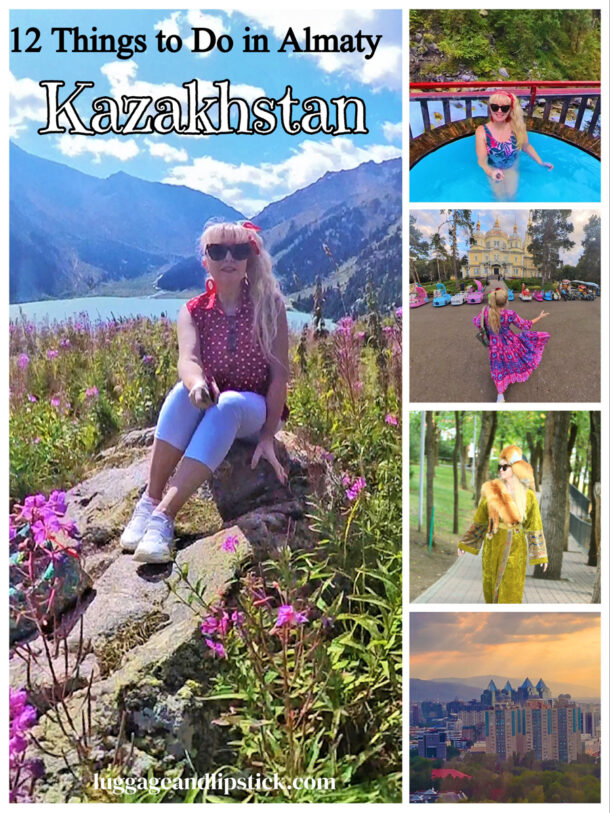
Click below to PIN so you can find things to do in Almaty again:
This article may contain affiliate/compensated links. For full information, please see our disclaimer.
About the Author
Patti Morrow is a travel influencer and founder of the award-winning international blog Luggage and Lipstick. TripAdvisor called her one of the “20 Baby Boomer Travel Bloggers Having More Fun Than Millennials,” and she was named one of the “Top 35 Travel Blogs” in the world.
She is also the star of the upcoming TV series “Destination Takeover,” which is scheduled to premiere in the near future.
Patti is the author of the book “Girls Go Solo: Tips for Women Traveling Alone,” and has over 150 bylines in 40 print and online publications, including The Huffington Post, International Living Magazine, Washington Post Sunday Travel, Travel Girl, Travel Play Live Magazine, and Ladies Home Journal. Her blog articles are consistently featured on Google’s AI search, as well as appearing on page one of Google search for specific keywords.
She has traveled extensively through six continents and more than 100 countries and island territories – putting her in an elite club of having traveled more than 99.99% of people! She is always looking for fabulous destinations, exotic beaches, and adventure activities for her Baby Boomer tribe.
Disclosure: The author was honored to be the guest of Visit Almaty and Kazakhstan Tourism during her stay, but as always, the opinions, reviews, and experiences are her own.

2 comments
Comment by Carla Marie Rupp
Carla Marie Rupp September 2, 2026 at 1:46 am
I love al these beautiful and fascinating places you described! I experienced some of them recently, and your beautiful descriptions give me great memories. Thanks. Almaty is a fabulous place to visit.
Comment by luggageandlipstick
luggageandlipstick September 2, 2026 at 10:47 am
Thanks for your kind words, Carla! I’m sorry we didn’t get a chance to reconnect with you and Jason in Almaty. I remember having a great time with you at the closing party in Marbella and also on the pre-FAM boat trip in Phuket. I hope everything is going great for you!